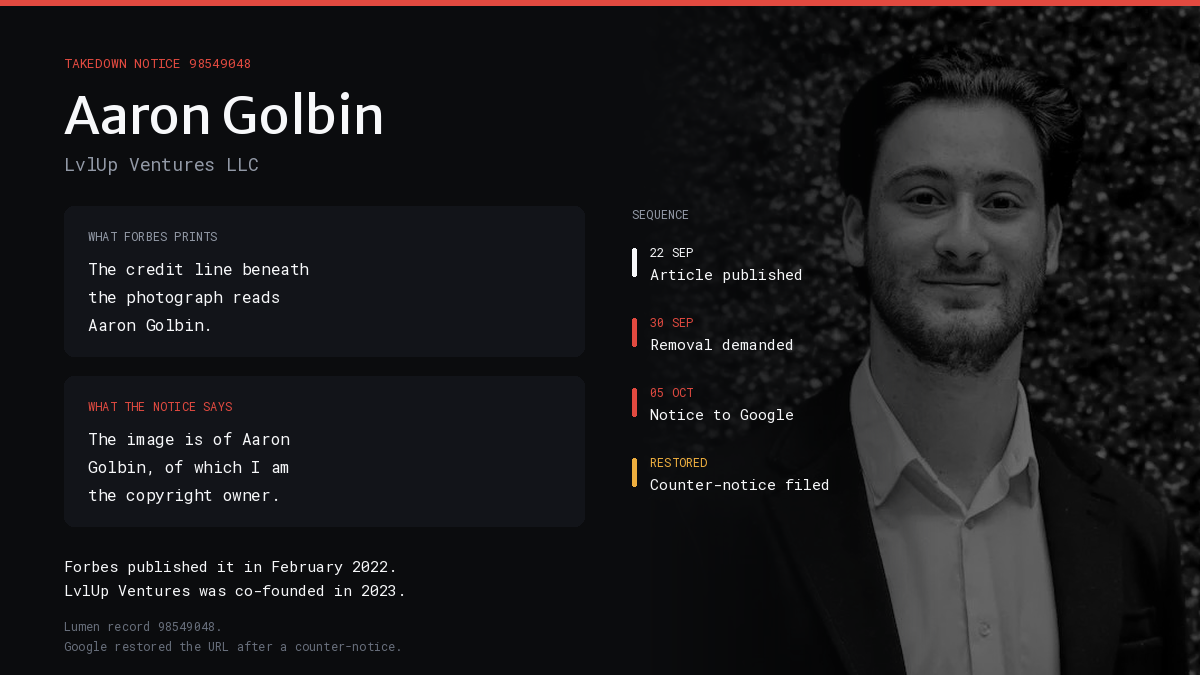
Aaron Golbin was 18 when Forbes photographed him for an interview about the businesses he had started at school. The credit line printed beneath that photograph is his own name. Three and a half years later, thirteen days after this site reported that founders accepted into his accelerator were told to buy software subscriptions, LvlUp Ventures told Google it owned the photograph and asked for the article to come down. Google removed the result.
The Lumen record of the October 5, 2026 notice carries one sentence of explanation. The image is of Aaron Golbin, it says, of which the sender is the copyright owner, used without any permission by this blog. It names forbes.com as the location of the original and this publication as the infringer.
The page it points to is a February 2022 Forbes interview, published under the byline of a Forbes contributor.
The Claimant and the Credit Do Not Match
A takedown notice asks the sender to state, under penalty of perjury, that it is authorised to act on behalf of the owner of the work. This notice was sent by LvlUp Ventures LLC and asserts the firm’s ownership.
Forbes credits the image to Aaron Golbin personally. A credit line is a publication’s record of who supplied a photograph, and this one names an individual rather than a company. Golbin co-founded LvlUp Ventures in 2023, a year after the interview ran. A firm that did not exist in its present form when the photograph was published is an unlikely owner of it, and the page the notice cites as its own proof says so on its face.
Nothing in the notice explains how the firm came to own an image Forbes attributes to someone else, or whether a photographer was involved at any point. The record shows a claim, and a source URL that contradicts it.
A Photo Claim Cannot Reach the Reporting
This publication uses the photograph to identify the subject of news reporting about his firm. That is ordinary press practice and the use copyright law treats most favourably. The purpose is journalism rather than commerce. The work is a publicity portrait of a businessman rather than a creative or artistic one. It is used to show who the article is about. And it takes nothing from the market for a headshot its own subject supplied to a business magazine. Golbin publishes under his own byline and issues press releases quoting himself. The photograph exists to be seen.
A notice built on an image can reach, at most, the image. The September report describes two founders who say they were told to buy paid software plans to secure accelerator places, and quotes Golbin’s own message to one of them saying virtually all the tools are entirely free. It records that no regulator has acted, that no lawsuit has been filed, and that nothing in it alleges unlawful conduct. It carries LvlUp’s own response in full.
A copyright claim over a portrait touches none of that. Yet the URL the notice asked Google to act on was the article, not the image file.
The Copyright Claim Was the Second Attempt
The notice to Google was not the firm’s first move. On September 30, eight days after the article appeared and five days before the copyright claim, LvlUp Ventures’ legal team wrote to this publication demanding the article be removed in its entirety within 24 hours.
That letter ran to seventeen numbered objections and made no copyright claim of any kind. It disputed the headline, the use of third-party database figures, the PitchBook comparison and the naming of staff, and it set out the firm’s case in detail: that payments for software go to third parties rather than to LvlUp, often around $10 a month, that requirements are disclosed before participation, that its Labs programming is separate from its investment funds, and that applicants were directed to the contacts responsible for their process. It offered to produce documentation. Those points are substantive, and they have been added to the original article, which now carries the firm’s response in full.
The demands went further than correction. The letter required removal of the article and of every excerpt, social post, summary and cached copy, steps to have search engines de-index it, preservation of all drafts, editorial notes, analytics and source communications, identification of the individuals who researched and wrote it, and preservation of identifying information relating to anonymous sources. A follow-up message, sent as the 24 hours ran out, described itself as a final pre-litigation notice and said the firm was prepared to proceed with formal legal escalation without further notice.
No reply was sent. The article was not removed, no response was made to the demand, and no proceedings have been filed. Five days after the deadline passed, the copyright notice reached Google and the search result came down.
The two approaches sit oddly together. A demand letter alleging false statements has to be argued, and the firm argued it at length. A copyright notice needs only an assertion of ownership, and it is acted on in days by a company that does not adjudicate it. One route required LvlUp to persuade somebody. The other required it to tick a box.
The URL Has Been Reinstated
This publication filed a counter-notice disputing the claim of ownership. Google has restored the URL.
That is the same outcome as the September takedown, where a sender claimed authorship of a land banking investigation published ten months earlier and Google found the request invalid within two days. Two notices, two removals, two restorations.
What the process does not do is price the interval. Between the filing and the restoration the article was absent from the results for the searches that would most obviously lead to it, which is the period that matters to anyone looking for information about a firm before dealing with it. Removal is immediate because the statute demands speed. Restoration requires the publisher to notice, object and wait. A claim that fails still buys the gap.
Conclusion
The sequence is short enough to state plainly. An article about LvlUp Ventures appeared on September 22. On October 5 the firm told Google it owned a photograph published by Forbes three and a half years earlier and credited there to Aaron Golbin.
A statement of ownership made under penalty of perjury is meant to be the straightforward part of a takedown notice. This one is contradicted by the page it cites, and it worked anyway, for a while. The article was never removed from this site. The search result was, until a counter-notice brought it back.
Disclosure: this report concerns a takedown notice and a legal demand filed against HannahHowell.com, the publication on which it appears. The notice details are drawn from the Lumen Database record. LvlUp Ventures and Aaron Golbin have been invited to comment, and any response will be published.