
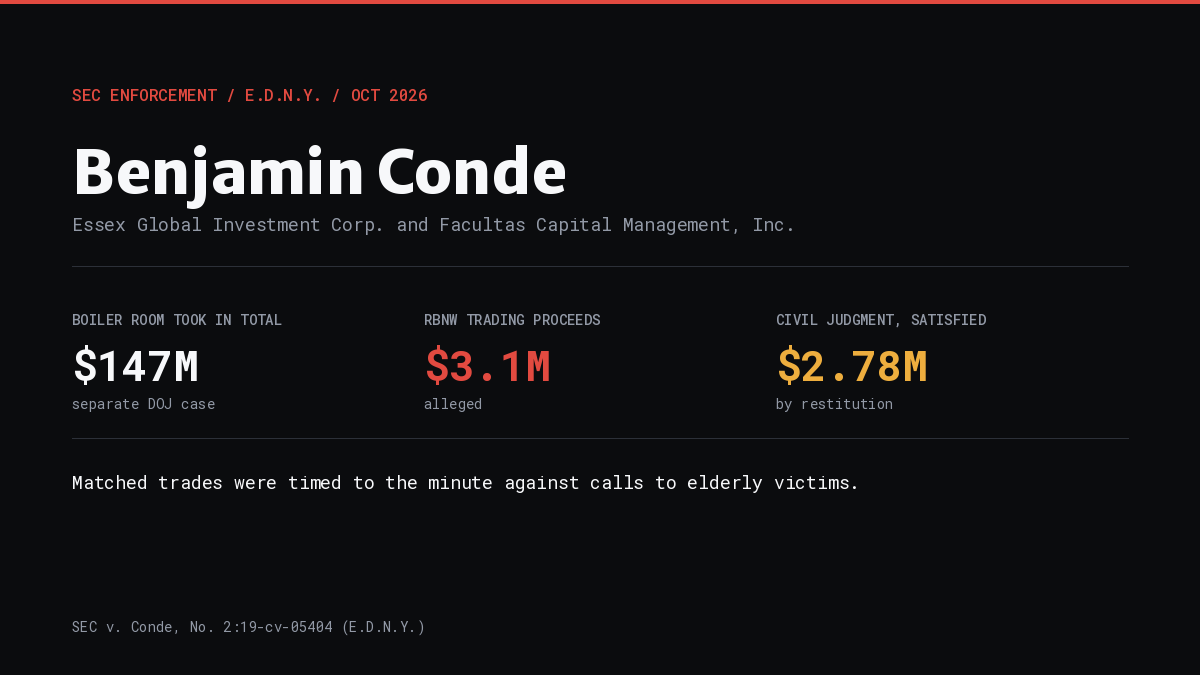
At 10:06 a.m. on 5 April 2017, sales staff at a Long Island boiler room called an elderly investor. At 10:09 a.m. Benjamin Conde called his own broker. At 10:11 a.m. the investor’s order to buy 50,000 shares of a penny stock executed at the same moment Conde sold 50,000 shares of the same stock at the same price. The Securities and Exchange Commission has just closed the civil case built on that sequence, seven years after filing it, and it describes Conde the same way at the end as it did at the start: a securities fraud recidivist.
What the complaint timed to the minute
The SEC’s 2019 complaint in the Eastern District of New York accuses Conde of orchestrating the manipulation of Renewable Energy and Power, Inc., traded under the ticker RBNW. He obtained 9.5 million shares through a convertible note issued to Essex Global Investment Corp., the firm he controlled, and deposited them in Essex’s brokerage account. Between March and July 2017 he is alleged to have paid a boiler room called Power Traders Press to call targeted victims and press them to buy RBNW, while he sold his own shares into the orders those calls produced.
The complaint lays out the mechanism call by call. On 27 April 2017 sales staff phoned a victim at 12:13 p.m. and stayed on the line seven minutes. At 12:33 p.m. Conde called his broker. At 12:34 p.m., while the same victim was still on the phone with the boiler room, an order for 10,000 shares at $0.47 executed at the identical moment Conde’s account sold 10,000 shares at $0.47. The complaint records several more of these pairings, each run through an encrypted messaging app set to delete messages automatically.
The boiler room was already a $147M case
Power Traders Press is not a name invented for this complaint. Prosecutors in the same district had already been building a case against the operation for years, and five days after Conde was indicted they announced prison sentences in it: ten years for the manager who ran it, six years for a cold caller who stole $341,883. That case described a scheme running from January 2014 to July 2017 that took $147 million from victims, many of them in their seventies, eighties and nineties, under the names Power Traders Press and My Street Research. Fourteen people were charged in it altogether. Conde’s RBNW scheme was one client relationship sitting inside that larger operation, running at the same time, through the same callers, and it has taken a separate seven year path through the courts.
Where the profits went
Conde did not work alone. He is accused of paying marketer Lawrence Isen of Marketbyte LLC roughly $236,000, about 13 percent of the RBNW profits, for introducing him to the boiler room. Prosecutors say about $2.85 million in trading profits moved from Essex through Conde’s accounts to Marketbyte, and that the boiler room’s own account executive wrote invoices for services that were never performed so the transfers would look like ordinary business. Conde and Isen were indicted together on conspiracy to commit securities fraud, wire fraud and money laundering, each carrying up to twenty years.
What the settlement actually collects
The civil judgment entered on 20 October 2026 orders Conde to pay $1,097,800 in disgorgement and $1,681,021.69 in prejudgment interest, a total of $2,778,821.69, alongside a permanent penny stock bar. The judgment itself states that this entire sum is deemed satisfied by the restitution and forfeiture already ordered against him in the parallel criminal case. The SEC is not collecting new money from Conde. It is closing the ledger on money a criminal court already took.
Two relief defendants named at the outset, Essex Global and Facultas Capital Management, were voluntarily dismissed along with the case’s conclusion. Relief defendants are never accused of wrongdoing themselves. They are named only because fraud proceeds passed through them, and their dismissal here closes out that part of the matter rather than resolving any allegation against them.
Conclusion
The word the SEC chose in 2019 and repeated in its press materials, recidivist, means the agency believed this was not Conde’s first run at manipulating a market, though the complaint itself does not spell out the earlier episode. What the record does spell out is a scheme that ran on a clock: a call to a victim, a call to a broker, a matched trade, each timed to the minute and routed through messages built to vanish. This publication has covered boiler rooms working the same playbook, from Christopher Bongiorno’s fake-broker operation to Francis Biller’s spoofed-number callers. What sets this one apart is scale within scale: a single manipulation scheme, inside a boiler room that was itself the engine of a $147 million fraud, closed out seven years later by a judgment that collects nothing a criminal court had not already taken.


